4/7/2026
Diamond Carat Weight vs Visual Size: Why Bigger Numbers Don't Mean Bigger Diamonds
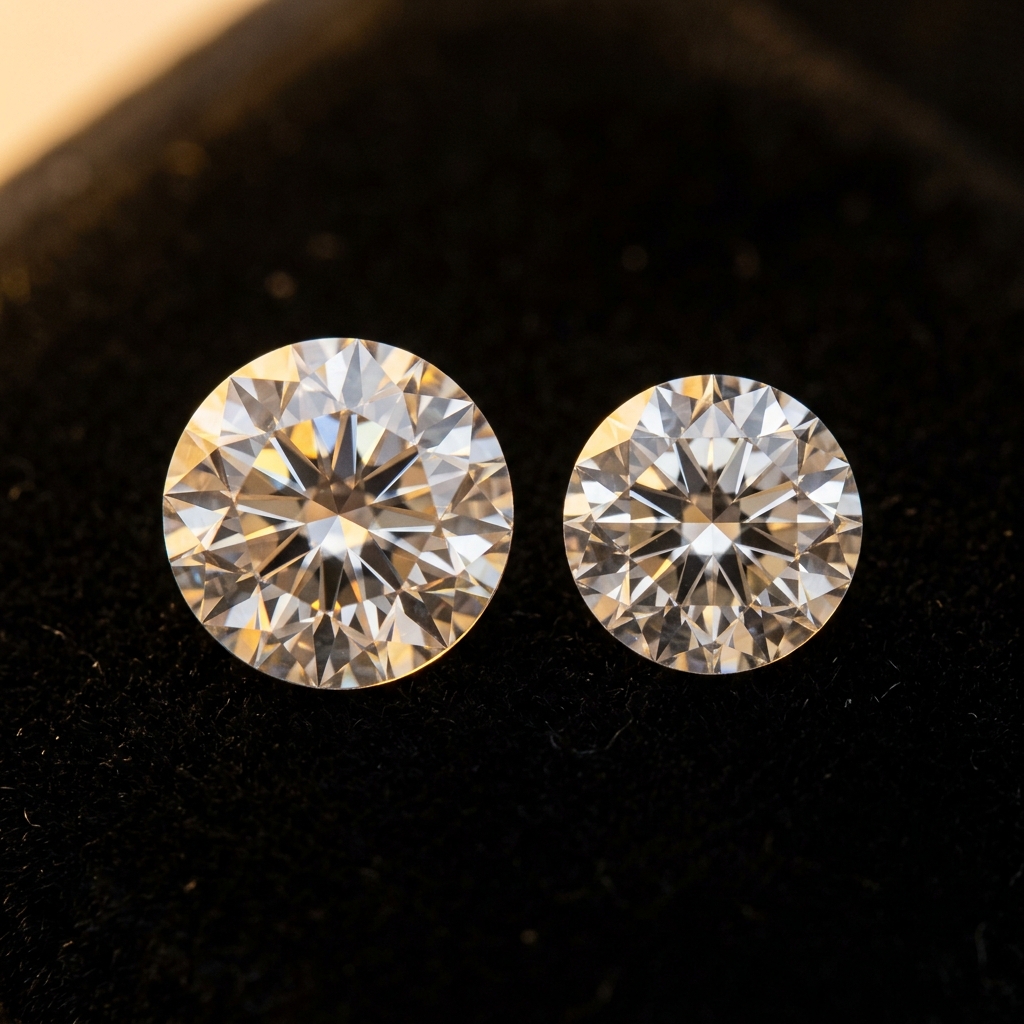
A 1.0-carat diamond can look like a 1.3-carat diamond — or a 0.85-carat diamond. The number on the certificate doesn’t tell you which.
If there is one number everyone memorizes when diamond shopping, it’s Carat. But as established in our Ultimate 4Cs Pipeline, what buyers believe they are paying for is almost never the reality. You are likely conflating carat with physical dimensions.
Carat is strictly a measurement of absolute mass. 1 carat equals exactly 0.2 grams. End of story. It says absolutely nothing about how much real estate the diamond will occupy on an engagement ring. If you want a diamond that looks massive, you need to stop shopping by weight and start shopping by spread.
Spread vs Depth: The Great Illusion
Imagine two identical pieces of dough. Roll one out into a wide, flat pizza. Roll the other into a dense, tall muffin. They both weigh exactly the same, but the pizza looks ten times wider.
Diamonds work the exact same way. If a cutter elects to cut a diamond very deep (hiding the mass in the bottom portion of the stone where it sits invisibly inside the ring setting), a 1.5-carat diamond might only measure 7.0mm across.
Conversely, a shallow-cut “spready” stone pushes the mass outward. That same 1.5-carat weight, cut with a wide emphasis, might measure 7.6mm across—giving the visual appearance of a much larger, more expensive diamond.
The trap to avoid: Do not buy blindly based on the Carat header. Check the exact millimeter dimensions printed on the IGI or GIA certificate. For a true 1.0-carat ideal-cut round diamond, you want a diameter measuring roughly 6.5mm. Anything less, and you are paying for dead weight hiding in the setting. Be warned, however: if a diamond is cut too shallow to artificially increase spread, light will leak through the bottom and kill the sparkle.
Not sure which grade to buy?
Take our 60-second quiz and we’ll tell you exactly what to look for.
The Shape Bias
Why do ovals seem so much bigger than rounds?
It’s all about geometry. The classic Round Brilliant cut is actually the worst diamond shape for “size per dollar.” It requires immense rough wastage to cut, and its perfectly symmetrical depth hides much of the carat weight.
Elongated shapes—like Ovals, Marquise, Emeralds, and Pears—are naturally much shallower and stretch the carat weight across the finger. A 1.50-carat Oval will appear significantly larger face-up than a 1.50-carat Round diamond. If absolute footprint is your goal, elongated fancy shapes are the answer.
The Magic-Number Markup Trap
In the mined diamond industry, prices jump exponentially at arbitrary zero-bound psychological markers: 1.00ct, 1.50ct, 2.00ct. A 0.99ct mined diamond might cost 30% less than a 1.00ct diamond of the exact same quality, simply because it lacks the badge of honor.
What jewelers won’t tell you is that this trap is much weaker for Lab-Grown Diamonds. Because LGD supply is abundant, the pricing curve is vastly more linear. You don’t have to resort to hunting down an obscure 0.94ct stone to aggressively “hack” the system like you do with mined diamonds. In 2026, finding a perfectly cut 2.0-carat LGD without facing a punishing ‘magic number’ tax is extremely feasible.
If you want to definitively balance budget, carat, and spread, use the Diamond Calculator. And if you’d rather leave the geometry to the experts, stop guessing.
Consult a Sizing Expert
We’ll source a diamond with maximum face-up spread and zero light leakage.
Carat is the most marketed C and the least informative one. For how it interacts with cut depth, color masking, and clarity tradeoffs, return to the 4Cs Complete Guide.
Find Diamonds that Maximize Visual Size at Eternity LGD →