4/8/2026
The 4 Biggest Red Flags When Buying a Diamond Online in 2026
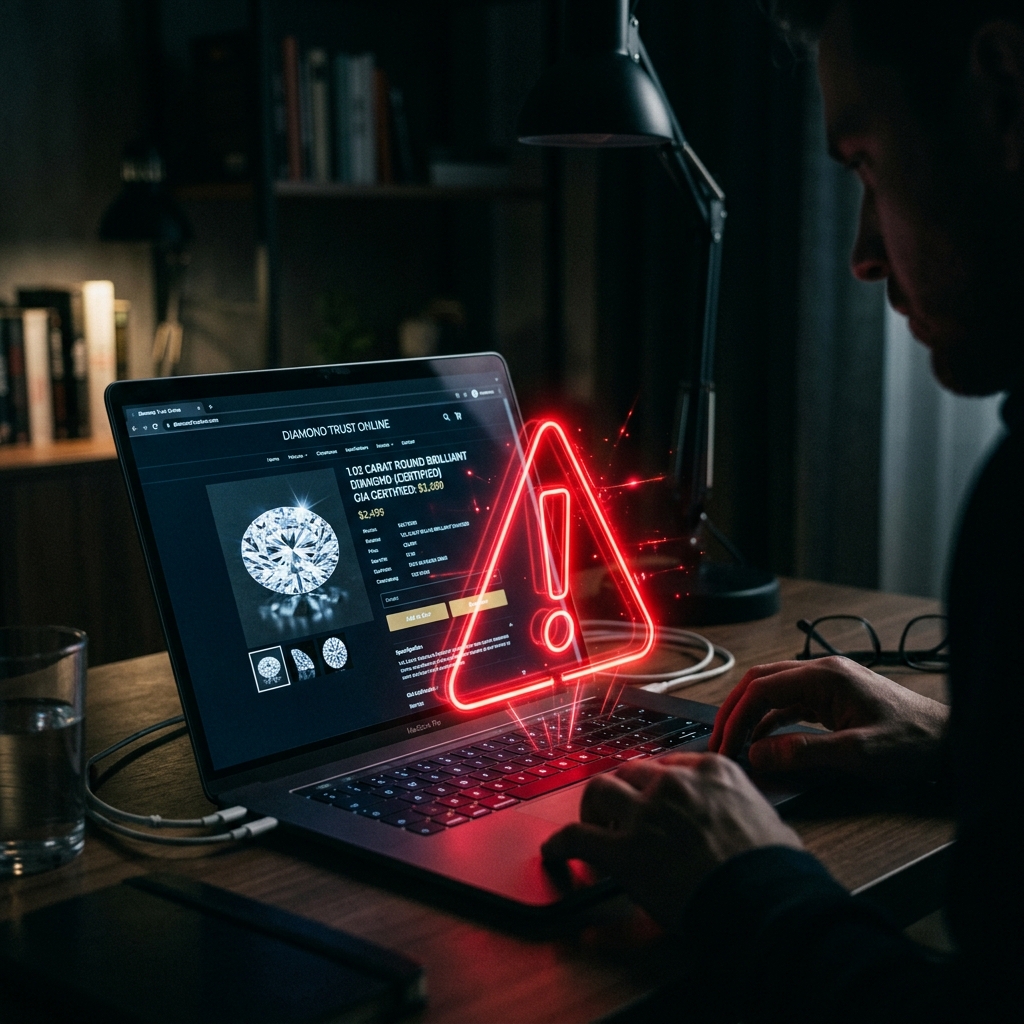
For $3,000, you can buy a flawless, icy-white, master-cut lab-grown diamond that outshines anything in a traditional mall jewelry store. For that exact same $3,000, you can also accidentally buy an improperly cut, brown-tinted stone with a heavily inflated certificate.
Why? Because the online diamond market thrives off of information asymmetry.
Big-box online retailers depend on you looking at three things: carat weight, price, and the “add to cart” button. They do not want you looking closely at the details. Here are the four biggest red flags that suggest you’re about to make a massive mistake.
1. “Only 1 Left At This Price!” Countdown Timers
This is the oldest trick in the e-commerce playbook, but it’s particularly insidious in the luxury jewelry space.
If you see a flashing countdown timer, or a banner reading “Sale ends in 12 hours!” on an engagement ring site, run away.
Diamonds are commodities. The global wholesale market for lab-grown carbon does not suddenly drop 40% for Labor Day, and it doesn’t spike randomly on Tuesday. Huge artificial “discounts” usually mean one of two things:
- The original “retail” price is a total fabrication to make you feel like you’re getting a deal.
- They are trying to rush you into checking out before you have time to look up the grading certificate on the official IGI/GIA database.
A reputable concierge or jeweler will hold a stone for you for 24 to 48 hours without high-pressure tactics so you can make a measured, confident decision.
2. Certificates From “In-House” Graders
Never, ever buy an uncertified diamond. But more importantly: never buy a diamond certified by a laboratory you’ve never heard of.
The only grading reports you should trust in 2026 are:
- IGI (International Gemological Institute): The undisputed gold standard for lab-grown diamonds.
- GIA (Gemological Institute of America): The original standard for mined diamonds, and highly respected for lab-grown.
- GCAL (Gem Certification & Assurance Lab): Excellent, rigorous grading.
If a jeweler offers an “In-House Certificate of Authenticity,” they are asking you to trust the person selling you the diamond to grade the diamond neutrally. This is a massive conflict of interest. Often, a stone graded “G / VS2” by an in-house or obscure lab will grade a “J / I1” by a legitimate lab like IGI.
[!WARNING] Always use the official IGI Verification Portal to cross-check the certificate number. If the lab couldn’t put a laser inscription on the diamond’s girdle matching the report, do not buy it.
Want a Diamond That Is Proven Genuine?
Every stone sourced by Skygem Concierge is independently verified via IGI or GIA at the wholesale level. Take our Quiz to see what a properly-vetted diamond should cost today.
3. Stock Photography Instead of the Real Stone
If the retailer is using a generic, computer-generated render of a diamond instead of a massive, 360-degree, 10x magnified video of the actual specific diamond you are buying, you are gambling blindly.
Especially with lab-grown diamonds, you must visually inspect the stone for growth defects.
- CVD diamonds can suffer from “blue nuance” (a slight bluish tint) or heavy, cloudy graining.
- HPHT diamonds can have internal metallic flux inclusions that cause magnetic attraction, or a distinctly brown/gray tint.
These defects do not show up on an IGI certificate, but they ruin the stone’s beauty. If you can’t view the diamond under studio lighting to check for a brown, gray, or blue undertone, you shouldn’t buy it.
4. Extremely Loose Return Policies
A legitimate diamond seller knows that buying online carries inherent anxiety. High-end jewelers mitigate this by offering ironclad, no-questions-asked return policies—typically 14 to 30 days.
If you encounter:
- “Restocking fees” hidden in the fine print (often 10% to 20%, which is devastating on a $5,000 ring).
- “Exchange only” policies for custom rings.
- Return policies that demand you ship the ring back at your own expense fully insured.
…you have found a company that expects returns and is trying to penalize you for them.
The Skygem Concierge Difference
Most remote buyers get overwhelmed by the sheer volume of “red flags” to check. The easiest way to avoid scams, markups, and mediocre stones is simply to use an expert who sits on your side of the table.
Our diamond concierges don’t own inventory, meaning they don’t care which stone you pick—so long as it’s the absolute best value on the global wholesale market. We verify the certificate, filter out CVD/HPHT growth defects, negotiate the wholesale cost, and have our master craftsmen set the ring perfectly.
Talk to an Expert, Not a Salesman
Book a zero-pressure consultation. We’ll find you the perfect diamond and guarantee it passes every test in the book.