4/1/2026
How to Verify an IGI or GIA Diamond Certificate (And Spot a Fake)
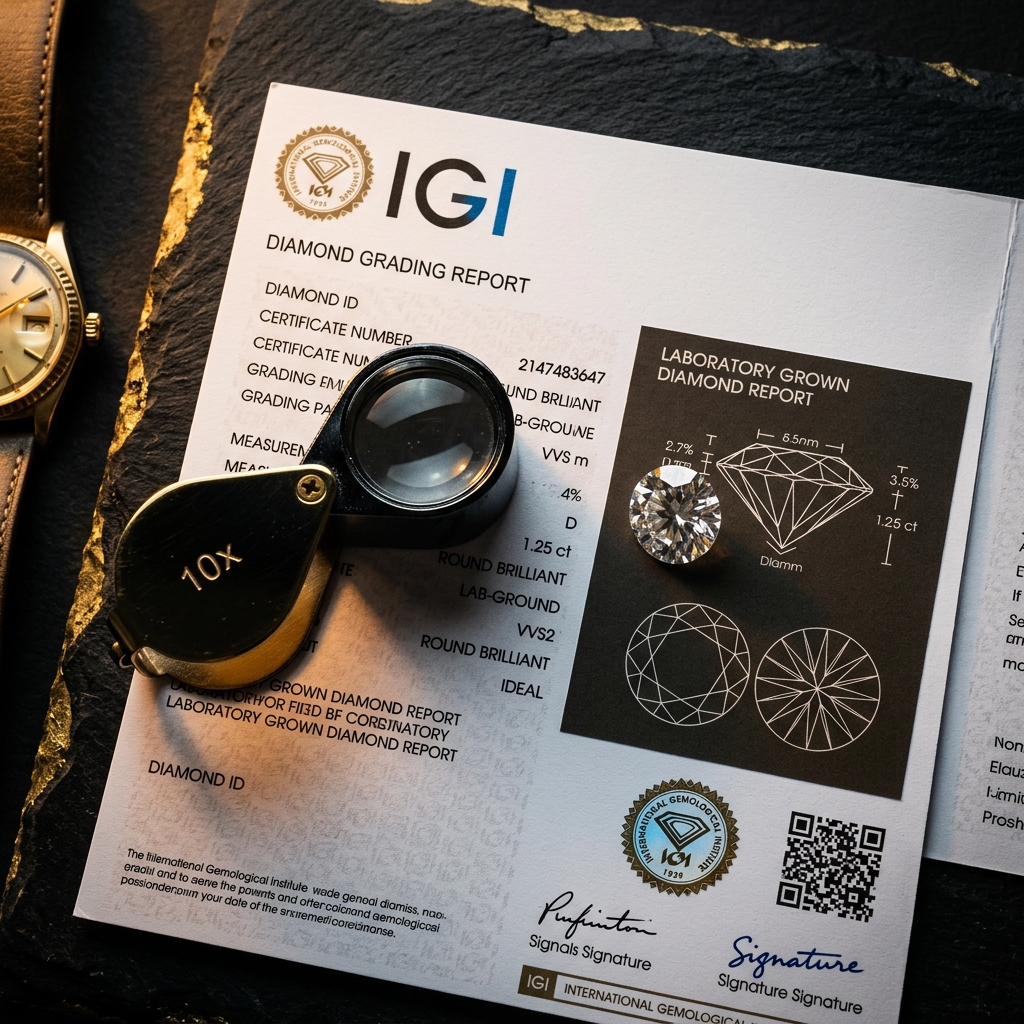
The single most important rule of buying any diamond—mined or lab-grown—is simple: Never buy an uncertified diamond. But in 2026, simply having a piece of paper isn’t enough. The rise of online diamond purchasing has unfortunately brought a rise in fraudulent, altered, or completely fake grading reports.
Whether you’re purchasing a 3-carat lab-grown oval or a modest 1-carat round brilliant, that diamond’s entire financial value is tied to its certification. If the paper is fake, you may be paying thousands for a stone worth hundreds.
Here is exactly how to verify your IGI (International Gemological Institute) or GIA (Gemological Institute of America) certificate, step-by-step.
Step 1: Use the Official Verification Portal
This is the fastest, most bulletproof way to ensure the physical or digital certificate you were handed actually exists in the laboratory’s master database.
Both IGI and GIA maintain public databases of every diamond they have ever graded.
- Locate the Report Number: Look at the top of your physical certificate for a 9-to-11 digit alphanumeric code (e.g.,
LG123456789). - Go to the Source:
- For IGI: igi.org/verify-your-report
- For GIA: gia.edu/report-check
- Cross-Check the Data: Enter the number. The portal will generate a digital copy of the report. Do not just look for a “Match Found” message. You must meticulously compare the carat weight, color grade, clarity grade, and physical measurements on the screen to the paper in your hand.
[!WARNING] Scam alert! Fraudsters will sometimes buy a genuine $500 IGI-certified diamond, print a fake certificate copying its exact report number, but change the grades on the paper to sell a different, lower-quality diamond for $3,000. If the physical measurements (e.g.,
8.12 x 5.44 x 3.32 mm) listed online don’t match the paper, walk away immediately.
Step 2: Check the Laser Inscription
Almost all certified lab-grown diamonds (and modern mined diamonds) feature a microscopic laser inscription on their girdle—the thin outer edge of the stone.
This inscription will almost always include the laboratory’s logo and the exact report number.
How to verify it: You cannot see a laser inscription with the naked eye. You need a jeweler’s loupe (10x to 20x magnification) or a digital microscope.
- If you are buying in person, demand the jeweler show you the inscription under a loupe before you hand over your card.
- If you bought online, take the ring to a local independent appraiser immediately upon receiving it.
- The laser-etched number on the diamond must perfectly match the number on your certificate.
If there is no inscription, and the certificate says there should be one, the diamond has likely been swapped.
Step 3: Examine the Physical Document
If you were handed a physical “printout” of a certificate rather than an original, be highly suspicious. Real grading laboratory certificates are printed on specialized, high-quality material featuring advanced security measures.
A genuine IGI or GIA report will feature:
- Micro-printing that remains crisp under a magnifying glass
- Holograms or metallic foil logos that shift in the light
- A unique QR code (on modern certificates) that scans directly to the official verifier
- Textured or watermarked paper
If your certificate feels like standard printer paper, has blurry text, or pixelated logos, it is likely a counterfeit.
Take the Guesswork Out of Certification
Every stone sourced by Skygem Concierge is independently verified directly with the issuing laboratory before it reaches you. Take our Quiz to find your perfect, fully authenticated diamond.
Step 4: Analyze the Clarity Plot
A “clarity plot” is a diagram found on most full-scale grading reports. It maps out the exact location, size, and type of every internal inclusion (crystal, feather, pinpoint) and external blemish inside the diamond.
Think of the clarity plot like a fingerprint. No two diamonds have the exact same inclusions in the exact same positions.
If you have a digital microscope or are working with an appraiser, compare the actual diamond to the map. If the map shows a large feather on the left side, but the physical stone is perfectly clean there and instead has a black crystal on the right, you are holding the wrong diamond.
The 3 Major Red Flags of a Fake Certificate
While verifying the report directly is the best defense, look out for these massive warning signs before you even get to that step:
- “In-House” Appraisals: Many jewelers will sell you a diamond with a “certificate of authenticity” printed by their own store. This is not a grading report. It is a marketing document. Independent labs like IGI and GIA have no financial stake in the diamond’s sale price, ensuring an objective grade. In-house graders do.
- Obscure Laboratory Names: If the certificate is from a lab you’ve never heard of (e.g., “Global Diamond Institute of America”), be wary. Some obscure labs exist solely to inflate grades for shady retailers, giving an I-color, SI2 diamond a “G-color, VS1” grade to justify a higher price. Stick exclusively to IGI, GIA, or GCAL.
- Missing “Lab-Grown” Disclosures: For lab-grown diamonds, a legitimate certificate will boldly and clearly state “LABORATORY-GROWN” across the top, and the laser inscription will usually include the letters “LG” before the report number.
The Ultimate Protection: The Independent Appraiser
The jewelry industry relies heavily on trust—but trust should always be verified.
When you purchase a diamond engagement ring online, you typically have a 14-to-30-day return window. The absolute safest way to verify your purchase is to schedule an appointment with an independent, third-party jewelry appraiser immediately after the ring arrives.
A professional appraiser will:
- Verify the laser inscription matches the certificate
- Verify the physical grades (color, clarity, cut) match the certificate
- Verify the metal purity of the setting
- Provide you with an appraisal document for insurance purposes
Working with a dedicated concierge service like Skygem eliminates this anxiety entirely. We source diamonds directly from top-tier cutters, verifying the GIA and IGI certificates at the wholesale level before the stone is ever set into a ring, ensuring you get exactly what you paid for.
Ready for a Fully Authenticated Ring?
Book a zero-pressure consultation. We’ll source an IGI or GIA certified stone and walk you through its actual grading report on a video call.